
Kitchen corners are some of the most underutilized real estate in any home. Those awkward 90-degree angles where cabinets meet often turn into black holes where Tupperware lids go to die and expired spices hide for years. But with the right corner storage solutions, homeowners can transform these dead zones into highly functional spaces that actually earn their keep. Whether working with standard base cabinets, wall-mounted corner shelving, or creative DIY hacks, the right approach to kitchen corner storage can add significant usable space without expanding the footprint. This guide walks through proven corner storage kitchen strategies that work in real homes, from classic Lazy Susans to modern pull-out systems and budget-friendly workarounds.
Key Takeaways
- Corner storage for kitchen transforms underutilized 90-degree angles into functional spaces, recovering 9–12 square feet of potential storage per corner cabinet.
- Lazy Susan systems and pull-out shelving are the most effective solutions: Lazy Susans cost $30–$60 and work best for diagonal-door cabinets, while pull-out systems ($150–$400) provide superior access for blind corners and heavy cookware.
- Proper corner organization improves kitchen workflow by placing frequently used items within arm’s reach of primary work zones like the sink, stove, and prep areas.
- DIY budget hacks like wire shelf risers, tension rods, and adhesive hooks deliver significant improvements for under $50 without requiring cabinet modifications.
- Always measure cabinet interior dimensions and door swing radius before purchasing corner storage solutions to avoid compatibility issues and returns.
- Upper corner shelves and countertop organizers maximize vertical space while floating shelves require heavy-duty L-brackets anchored into wall studs for safe weight distribution.
Why Kitchen Corner Storage Matters More Than You Think
Corner cabinets in kitchens typically measure 36 inches wide on each wall, creating roughly 9–12 square feet of potential storage that’s easy to waste. Standard rectangular shelves in corner base cabinets leave 40–50% of the space unreachable without crawling inside, a design flaw that’s plagued kitchens for decades.
Proper corner storage kitchen solutions address three core problems: accessibility, visibility, and dead space. When items sit more than 18 inches deep or behind a fixed shelf edge, they effectively disappear. Homeowners end up buying duplicate items because they can’t see what they already own, leading to clutter and wasted money.
Beyond pure square footage, corner storage solutions also improve workflow. In a well-designed kitchen, the most frequently used items should sit within arm’s reach of primary work zones. Corners often fall at natural transition points between sink, stove, and prep areas, making them ideal for storing pots, mixing bowls, or small appliances if organized correctly.
For kitchens under 150 square feet, maximizing corner storage isn’t optional, it’s essential. Every cubic inch counts, and leaving corners underutilized means sacrificing counter space or cabinet real estate elsewhere. Even in larger kitchens, poor corner organization creates bottlenecks and frustration during meal prep.
Best Corner Cabinet Storage Solutions
Lazy Susan Systems
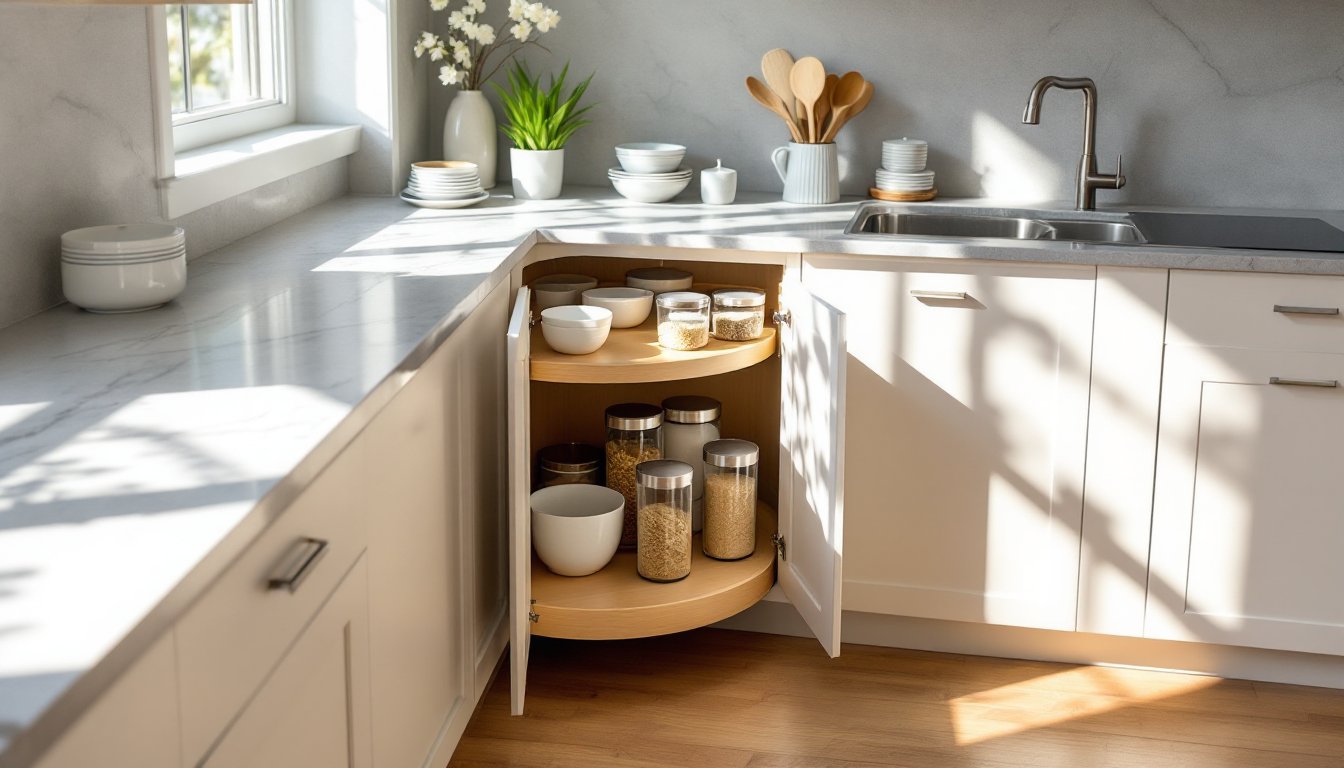
The Lazy Susan remains the most popular corner storage cabinet kitchen solution for good reason: it’s simple, affordable, and dramatically improves access. These rotating shelves come in two main configurations.
Full-round Lazy Susans work best in peninsula or island corners where the cabinet has a centered door. The entire circular shelf (typically 28–32 inches in diameter) spins on a central pole. Look for models with 3-inch raised edges to prevent items from sliding off during rotation. Ball-bearing mechanisms last longer than plastic pivot points, especially under heavy loads like small appliances or canned goods.
Kidney-shaped (or pie-cut) Lazy Susans fit standard corner base cabinets with a diagonal door. The cut-out section allows door clearance while maximizing usable surface area. Two-tier systems double capacity but require at least 30 inches of interior height to accommodate both shelves comfortably.
Installation is straightforward: most units mount to the cabinet floor with 4–6 screws through pre-drilled holes. Confirm the door swing won’t interfere with the shelf edges before ordering. Some budget models use stamped metal shelves that can rust in humid kitchens, polymer or wood shelves hold up better long-term.
Pull-Out Corner Drawers and Shelves
For those who want full visibility and access, pull-out corner shelving systems outperform Lazy Susans. These units mount on heavy-duty slides that pull the entire shelf assembly forward and sometimes swing out into the room.
Blind corner pull-outs tackle the trickiest configuration: cabinets where one side extends behind an adjacent cabinet face. When the door opens, wire or solid shelves slide forward on telescoping rails, then swing 90 degrees to expose items stored in the blind section. Quality units support 75–100 pounds and use soft-close dampeners to prevent slamming.
Installation requires more labor than a Lazy Susan. Expect to remove existing shelves, confirm proper clearance for the slide mechanism, and precisely position mounting brackets. Some models demand 1–2 inches of side clearance, which won’t work if existing cabinets sit tight against walls or appliances. A drill, level, and stud finder are essential. Plan on 2–3 hours for a first-time install.
Swing-out shelf systems work similarly but rotate on hinges rather than sliding rails. These suit corner cabinets with full-width doors. When the door opens, the shelves swing outward, exposing items stored deep in the corner. They’re easier to install than slide-out systems but require more floor clearance when open.
Both pull-out systems cost significantly more than Lazy Susans, $150 to $400 depending on size and brand, but they eliminate the need to reach around a spinning shelf. For homeowners with mobility challenges or anyone storing heavy cookware, the investment pays off in daily usability.
Corner Storage Ideas for Open Shelving and Countertops
Not all corner kitchen storage involves cabinets. Upper corners and countertop angles can be just as problematic, and just as fixable.
Floating corner shelves turn awkward wall junctions into display and storage space. Install two or three triangular shelves in an upper corner to hold mugs, small plants, or spice jars. Use heavy-duty L-brackets rated for at least 50 pounds each, anchored into wall studs, not just drywall. Standard 3/4-inch pine or poplar shelving works fine: for heavier loads like small appliances, use 1-inch hardwood or plywood with solid wood edging.
Measure carefully: shelves should sit at least 18 inches above the countertop to avoid head-bumping, and upper shelves need 10–12 inches of clearance between tiers for easy access.
Countertop corner organizers make use of dead zones where counter space narrows. Tiered lazy susans (6–10 inches tall) corral oils, condiments, and spices without blocking sightlines. Corner sink caddies with suction feet hold sponges and brushes in otherwise wasted space beside the faucet.
For deeper counters, appliance garages built into corner cabinets keep toasters, blenders, or coffee makers accessible but out of sight. These require a cabinet with a roll-up door or hinged tambour front. Retrofit kits are available, but most need minor carpentry: cutting an opening in the cabinet back for electrical access and installing a shallow shelf inside.
Diagonal corner sinks free up more usable counter space than standard configurations by eliminating the hard-to-clean gap where two countertops meet at a right angle. Pair a corner sink with pull-out storage beneath to maximize both counter and cabinet efficiency.
DIY Corner Storage Hacks on a Budget
Homeowners don’t need to gut cabinets or spend hundreds to improve corner storage. A few low-cost hacks deliver real gains.
Wire shelf risers ($10–$20 each) instantly double the usable height inside corner cabinets. Stack plates or bowls on the lower level, store lids or cutting boards on the upper tier. Adjustable models work better than fixed-height versions because cabinet interiors vary.
Tension rods installed vertically in a corner cabinet create slots for storing baking sheets, cutting boards, and trays on-edge rather than stacked flat. Use two rods spaced 1–2 inches apart, wedged between the cabinet floor and ceiling. This keeps items visible and prevents the avalanche effect when pulling one out.
Lazy Susan inserts for existing shelves cost $15–$30 and require zero installation. Drop a turntable onto any fixed shelf to gain rotating access. They’re not as stable as mounted systems but work fine for lighter items like spices, canned goods, or boxed staples.
Adhesive hooks on the inside corner of cabinet doors hold measuring cups, pot holders, or small utensils. Use 3M Command hooks rated for the item weight: standard suction cups fail in humid kitchen environments.
For open corners, freestanding wire racks or baker’s racks add shelving without any permanent installation. Look for units designed with a triangular or wedge-shaped footprint to fit snugly into 90-degree corners. These work especially well in rental kitchens where cabinet modifications aren’t allowed.
Another budget-friendly option: repurpose a small bookshelf or storage cart in a corner. Mobile units on casters can roll out for access and tuck back into place when not needed, making them ideal for tight kitchens where space is at a premium.
How to Choose the Right Corner Storage for Your Kitchen Layout
The best corner storage solution depends on cabinet configuration, budget, and how the kitchen gets used.
For blind corner base cabinets (where one cabinet extends behind another), pull-out systems or swing-out shelves deliver the best access. Lazy Susans struggle in true blind corners because part of the rotating shelf disappears behind the cabinet face.
For diagonal-door corner cabinets, kidney-shaped Lazy Susans are the most cost-effective upgrade. The pie-cut design maximizes usable surface while maintaining door clearance.
For peninsula or island corners with full access from a centered door, full-round Lazy Susans or multi-tier carousel systems work beautifully. These cabinets don’t have blind zones, so simpler solutions perform well.
For upper corner cabinets, consider how often items stored there get accessed. Infrequently used serving dishes or seasonal items can sit on fixed shelves. Everyday mugs, glasses, or spices benefit from a small Lazy Susan or pull-down shelving system.
Budget matters. A basic Lazy Susan costs $30–$60. Pull-out systems run $150–$400. Full cabinet replacement with modern corner solutions starts around $500 per cabinet, installed. DIY hacks like shelf risers and tension rods deliver improvements for under $50 total.
Finally, measure before buying. Note interior cabinet width, depth, and height, plus door swing radius. Most corner storage systems list minimum clearances, ignoring these specs leads to returns and frustration. When in doubt, trace the cabinet footprint on cardboard and test-fit the proposed solution before ordering.